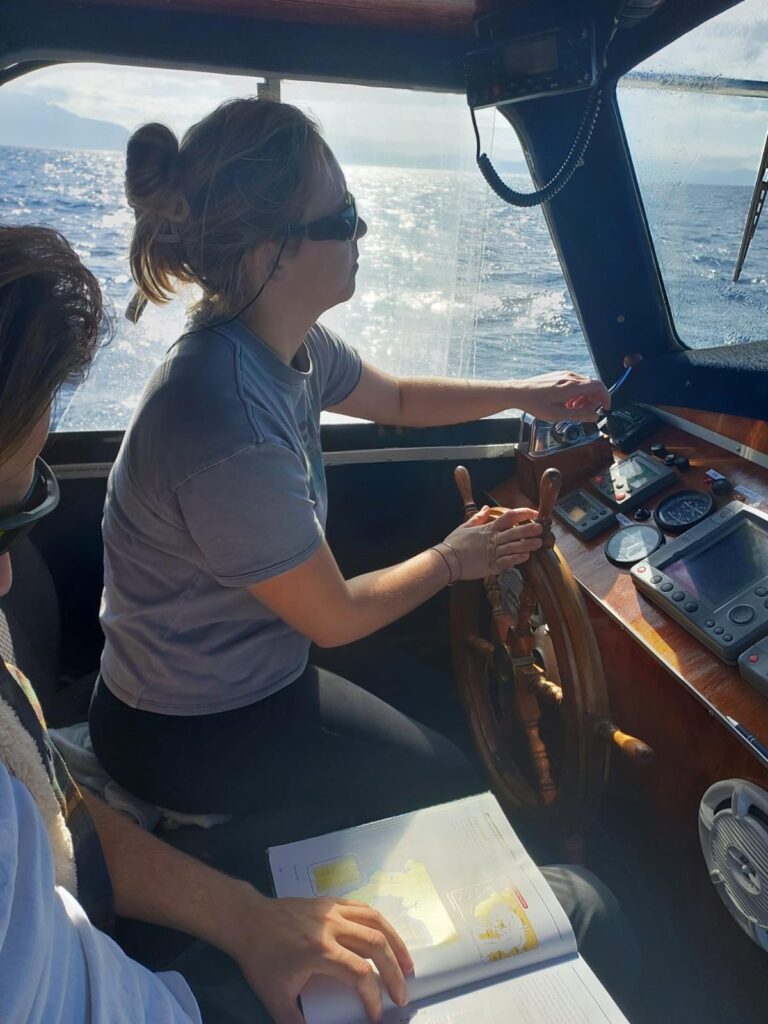
The duration of the preparation is 4 days, followed by a 1 to 2-day exam depending on the number of candidates. The 4-day will allow candidates to tweak their knowledge and ability and fill in any gaps or improve any weaknesses.
The duration of the exam is 8 to 12 hours per candidate, during which you will have to demonstrate a wide breadth of existing knowledge and skippering skills. You will start and finish your course in Gibraltar.
What’s Included
- Course Material
- Accommodation Can alsEo be provided
- Snacks, and drinks provided
- Exam Fee Included
Previous Experience Required:
- 50 days at sea
- 5 days as skipper
- 2500 miles logged (minimum 50% Tidal required)
- 5 passages of over 60 miles, including 2 overnight and 2 as skipper
- SRC/VHF radio operators’ certificate
- valid First Aid certificate
- Minimum age is 18
Yachtmaster Offshore Exam Syllabus
Candidates may be given the opportunity to demonstrate knowledge of competence in the areas listed below. In each section the examiner will expect to see the candidate take full responsibility for the management of the yacht and crew. In Yachtmaster Offshore exams the candidate will be expected to demonstrate competence based on broad experience.
1. International Regulations for Preventing Collisions at Sea
Questions will be confined to the International Regulations and although candidates must be aware of the existence of Local Regulations, they will not be expected to memorise specific local regulations.
- General rules (1-3)
- Steering and sailing rules (4-19)
- Lights and shapes (20-31)
- Sound and light signals (32-37)
- Signals for vessels fishing in close proximity (Annex II) D
- Distress signals (Annex IV)
2. Safety
Candidates will be expected to know what safety equipment should be carried on board a motorboat, based either on the recommendations in the RYA Boat Safety Handbook (C8), the ISAF Special Regulations or the Codes of Practice for the safety of Small Commercial Vessels. In particular, candidates must know the responsibilities of a skipper in relation:
- Safety harnesses
- Lifejackets
- Distress flares
- Fire prevention and fighting
- First Aid equipment
- Liferafts Knowledge of rescue procedures
- Pumps
- Tpa’s
- Shut off valves
- Emergency steering
- Helicopter rescue
3. Boat Handling
Candidates for Yachtmaster Offshore will be expected to conduct exercises such approaching all berthing situations in various conditions of wind and tide Recovery of man overboard. Towing under open sea conditions and in confined areas Boat handling in confined areas. Boat handling in heavy weather. Use of warps for securing in an alongside berth and single engine manoeuvres.
4. General Seamanship, including maintenance
- Properties, use and care of synthetic fiber ropes
- Knots
- General deck-work at sea and in harbour
- Engine operations – routine checks and service requirements
- Improvisation of jury rigs following failure
5. Responsibilities of the Captain
- Can organise the yacht and manage the crew
- Communication with crew
- Delegation of responsibility and watch-keeping organisation
- Preparing a yacht for sea and for adverse weather
- Tactics for heavy weather and restricted visibility
- Emergency and distress situations
- Planning and provisioning for a cruise
- Has knowledge of local Customs procedures
- Standards of behaviour and courtesy
6. Navigation
- Charts, navigational publications and sources of navigational information
- Chartwork, including position fixing and shaping course to allow for tidal stream and leeway
- Tide and tidal stream calculations
- Buoyage and visual aids to navigation
- Instruments including compasses, logs, echo sounders, radio navaids and chartwork instruments
- Passage planning and navigational tactics
- Pilotage techniques
- Navigational records
- Limits of navigational accuracy and margins if safety
- Lee shore dangers
- Use of electronic navigation aids for passage planning and passage navigation
- Use of Radar
7. Meteorology
- Definition of terms
- Sources of weather forecasts
- Weather systems and local weather effects
- Interpretation of weather forecasts, barometric trends and visible phenomena
- Ability to make passage planning decisions based on forecast information